
Battery Failures Confirmed Before Replacement Begins
Battery Testing and Replacement in Mulliken for vehicles that fail to start or show slow-crank and charging irregularities
A battery that cranks slowly on a cold morning or fails to start a vehicle that sat overnight is a familiar problem across Mulliken, Ionia, and Lake Odessa, where older vehicles with high mileage are routinely asked to start on batteries well past their rated service life. The harder diagnostic question is whether the battery is the cause or whether a failing alternator or a parasitic current draw is pulling it down. JW's Automotive tests both the battery and the complete starting and charging system before any replacement is recommended, so the part being replaced is confirmed as the actual failure rather than the first suspect.
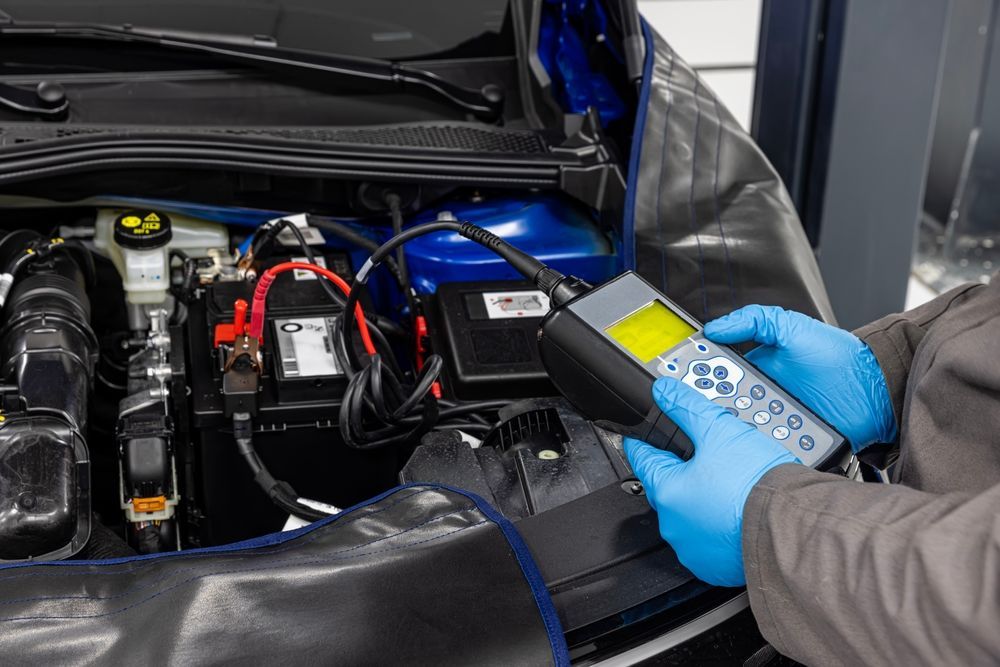
The technician load-tests the battery under simulated starting conditions — a resting voltage check alone is not sufficient to identify a battery that will fail under the current demand of cranking a cold engine. From there, alternator output is measured at the battery terminals at idle and under electrical load to confirm the charging system is maintaining the battery correctly once the engine is running. A current draw test identifies any circuit keeping the battery from fully recharging when the vehicle is parked. Each result is shown to you before a replacement battery is sourced, so the decision to replace is grounded in test data rather than age or guesswork.
Bring your vehicle in for a battery and charging system test to identify the specific cause before committing to a replacement.
Why Charging System Testing Comes Before Battery Replacement
Replacing a battery in a vehicle with a failing alternator produces a vehicle that starts once and then fails again within days, because the new battery is never being recharged to full capacity. Alternator output specifications vary by vehicle — a charging voltage that reads within normal range at idle may fall below the battery's maintenance threshold under air conditioning and lighting loads, which is why output is checked under realistic electrical demand rather than at base idle only. Parasitic draw diagnosis adds another layer: a module that fails to go to sleep, a relay stuck closed, or an accessory wired incorrectly can pull enough current to drain a healthy battery in under 48 hours.
After the replacement battery is installed at JW's Automotive, the charging voltage is confirmed at the battery terminals with accessories running to verify the alternator is maintaining the system correctly. The old battery is taken back as a core as part of the transaction — core handling is managed at the counter rather than requiring a separate return. What you should notice after a confirmed battery replacement with a verified charging system is reliable starts across varying temperatures and consistent electrical system behavior without the slow-crank episodes that preceded the failure.
Battery specification matters more on late-model vehicles where the battery management system communicates with the ECU — some require a relearn or registration procedure after replacement to calibrate charging rates correctly for the new battery's capacity. This is a step that is skipped on straightforward older vehicles but matters significantly on newer European and some domestic designs, and it is identified during the diagnostic phase rather than discovered after the fact.
Questions About Battery Testing and the Replacement Process
These questions address how battery and charging system testing is performed, what the process includes, and how the replacement decision is made.
What does a load test show that a voltage check does not?
A resting voltage check shows whether a battery holds a surface charge, but a load test draws current at a level that simulates actual engine cranking — a battery can read 12.6 volts at rest and drop below the minimum cranking threshold the moment it is asked to power a starter motor, which is the failure condition that matters.
How is a parasitic drain identified during the diagnostic process?
The technician connects a current meter in series with the battery and monitors draw after the vehicle's modules complete their sleep cycle — typically 20 to 45 minutes — then pulls fuses individually to isolate which circuit is responsible for current above the acceptable threshold.
Why does alternator output need to be checked under electrical load rather than just at idle?
Alternator output at idle on a warm engine can read within normal range while the unit is unable to sustain voltage under the combined draw of headlights, rear defrost, blower motor, and climate control — conditions that represent a typical evening drive and the exact scenario where a marginally functioning alternator fails to keep pace.
What does battery registration mean and which vehicles require it?
Some newer vehicles use an intelligent charging system that adjusts alternator output based on battery state of charge and age; installing a new battery without registering it to the ECU causes the system to treat the new battery as an old one and overcharge it, shortening its service life — this procedure is identified during the diagnostic review for applicable vehicles in Mulliken.
How do you know the replacement battery is the correct specification for your vehicle?
Battery specification includes cold cranking amps, reserve capacity, and physical group size — a battery with adequate CCA but insufficient reserve capacity for a vehicle with high accessory demand will cycle through discharge more rapidly than the alternator can recover, so spec matching against the manufacturer's requirement is confirmed before the part is ordered.
JW's Automotive also performs battery testing and replacement in Grand Ledge, Charlotte, Holt, and Lake Odessa. To have your battery and charging system tested and the results reviewed before any replacement decision is made, call JW's Automotive at (517) 731-6496.