
Tires Mounted and Set Up for the Way You Drive
Tire sales, mounting, and alignment in Mulliken for pickups and SUVs running mixed highway and gravel routes
Uneven shoulder wear on a truck tire is often the first visible sign that something in the steering or suspension geometry is off—but it only becomes obvious after enough miles have passed to show the pattern clearly. JW's Automotive in Mulliken sells, mounts, and balances tires, then coordinates the alignment as a sequenced follow-on step so the vehicle leaves set up correctly rather than rolling out on fresh rubber with angles still off. That coordination matters because alignment done before other suspension work is undone by the repair itself, while alignment done after locks in the corrected geometry.
Tires are inspected first for wear pattern, age, and any damage to the sidewall or tread before mounting. Wear pattern tells the shop whether an alignment problem or suspension issue was involved—cupping suggests shock absorber wear, one-edge wear points to camber or toe error—so the inspection informs the service sequence rather than treating each item as unrelated. Once mounted and balanced, the alignment is scheduled at a dedicated alignment shop the following day, after any other service work is finished, so the vehicle is set to specification as the final step.
Request a tire inspection at JW's Automotive to review current wear patterns and get a clear picture of what the alignment and service sequence should look like for your vehicle.
The Difference Between Mounting Tires and Setting Up the Vehicle
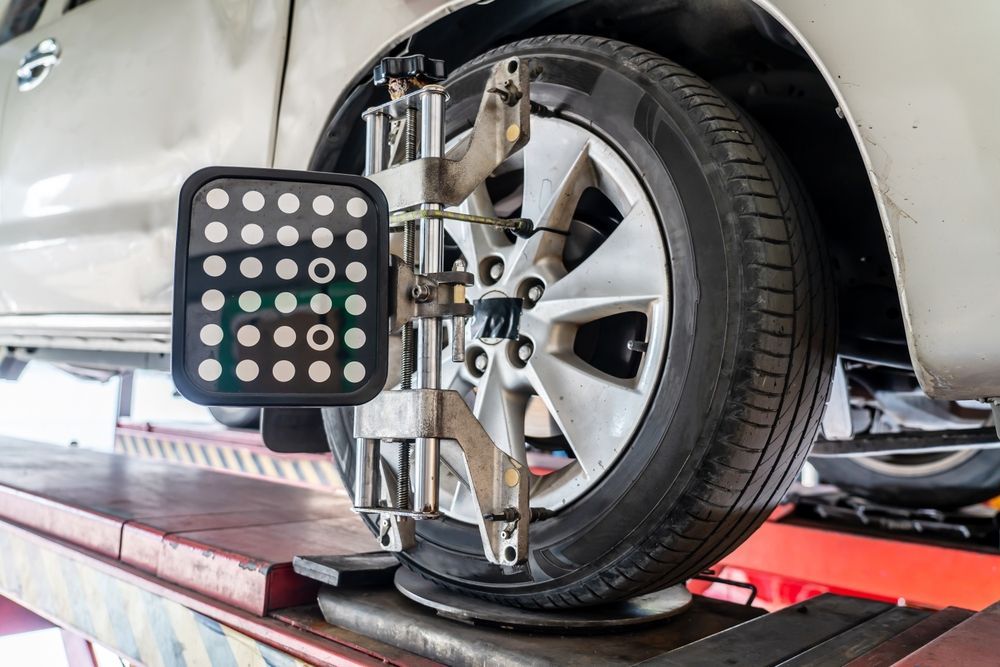
Mounting and balancing a tire gets weight distributed evenly around the wheel so there is no vibration at speed—that is the mechanical minimum. Alignment is a separate measurement process that sets the angles at which all four tires contact the road: toe, camber, and caster adjusted to the vehicle manufacturer's specification for the way the vehicle is loaded and driven. JW's Automotive uses a dedicated alignment shop for that measurement work rather than a general rack, which means the angles are set by equipment and technicians focused specifically on alignment rather than as an add-on at a general service bay.
After the full sequence is complete, the most immediate change is steering feel: a properly aligned vehicle tracks straight without the driver making continuous small corrections, and the steering wheel sits centered. Over the following weeks, tire wear evens out across the tread surface rather than loading one edge. Drivers in Mulliken and Grand Ledge running pickups on mixed road surfaces will notice the difference in stability particularly on highway segments where a misaligned truck requires active correction to hold a lane.
The scheduling sequence JW's Automotive uses—other service work completed the day before, alignment the following day—ensures that new suspension or steering components are in place before the alignment is measured, so the final angles reflect the actual repaired state of the vehicle rather than a baseline that will shift once parts are replaced.
Common Questions About This Service
Tire and alignment service involves a sequencing decision that affects how long the results last, and these questions come up often when customers are trying to understand why the steps are done in a specific order.
What does the tire inspection look at before mounting?
The shop reviews tread depth, wear pattern across the tread surface, sidewall condition, and age, because a tire that looks adequate on depth alone may show a wear pattern that points to an alignment or suspension issue that should be addressed before new tires go on.
Why is alignment done the day after the other service work?
If suspension components are being replaced at the same appointment, the alignment angles will change once those parts are installed. Completing the mechanical work first and scheduling alignment as the final step means the measurement reflects the vehicle's actual repaired geometry.
How does wheel balancing differ from alignment?
Balancing corrects the distribution of weight around the wheel and tire assembly to eliminate vibration at speed; alignment corrects the angles at which the tires contact the road surface. Both affect tire wear and handling, but through different mechanisms and require different equipment.
What wear patterns on a pickup or SUV tire suggest an alignment problem?
Wear that is heavier on one edge of the tread than the other typically indicates a camber or toe error; feathering across the tread surface often points to a toe setting that is out of specification. Either pattern will return on new tires if the underlying angle is not corrected.
Why does JW's Automotive use a dedicated alignment shop rather than handling it in-house?
Dedicated alignment equipment and the technicians trained on it produce more consistent angle measurements than general-purpose racks, and separating the measurement step from the mechanical work means each part of the job is handled by the appropriate setup.
JW's Automotive also performs tire and alignment service for customers from Grand Ledge, Charlotte, Holt, and Lake Odessa. Call (517) 731-6496 to set up tire service and confirm the alignment scheduling for your specific vehicle and repair needs.